
Antelope County Civil Docket Searches
Nebraska JUSTICE is the statewide entry point for an Antelope County civil docket search. Pick your court level first. County Court covers small claims. It also handles civil matters within its concurrent jurisdiction, probate, guardianship or conservatorship, and protection orders. District Court handles general civil actions, domestic relations, major civil matters, and County Court appeals. Filtering by Antelope alone will not sort that out for you.
A full party name is the best starting point for a docket search. County, case type, year, judge, attorney, and case number can narrow results. That works where the tool allows. JUSTICE charges a one-time $17 fee. It lags by approximately 24 hours. A search returns up to 30 public results, and grants a three-day access window. No results? Try different spellings or another court level. A different case type or a wider date range can also help before assuming the case is not there.
- Open JUSTICE and choose the County Court or District Court path that fits the civil matter.
- Search by complete party name or case number, then narrow to Antelope County with case type and year where useful.
- Confirm the court, caption, and category before opening the public case detail and register of actions.
- Read the dated sequence for a complaint or petition, service, answer, motions, notices, orders, judgment, and appeal activity.
- Use the court level and case number when asking the clerk for an unavailable document or certified copy.
Antelope County Civil Court Levels
Which court holds the docket depends on the kind of civil matter. Antelope County Court is a limited-jurisdiction court. It handles small claims along with specified civil and statutory matters. Antelope County District Court is the general-jurisdiction court for major civil cases and domestic relations, and it takes most County Court and agency appeals. The clerk split runs along the same line: the County Court Clerk Magistrate keeps County Court files, while the Clerk of the District Court keeps District Court files.
Probate and guardianship files live in County Court, though a public case index never means every personal, medical, or sensitive paper is viewable. City offices hold ordinances and administrative records, but Antelope posts no separate municipal civil docket. A city ordinance court case belongs with County Court, not a city portal.
| Record type | Usual Antelope docket route | Custodian |
|---|---|---|
| Small claims, probate, guardianship, County Court civil | County Court | County Court Clerk Magistrate |
| General civil and domestic relations | District Court | Clerk of the District Court |
| County Court appeal | District Court appellate action | Clerk of the District Court |
Civil Dockets: What They Show
A civil register in Antelope County lays out the case in order, entry by entry. Expect the court and county, case ID, caption, subtype, filing date, judge, parties, attorneys where public, status, financial fields, settings, and links to any available documents. The register also tracks the main civil steps. A complaint or petition, summons and return of service, answer or counterclaim, motion, notice, order, judgment, post-judgment work, and appeal each get an entry.
The register is not the full pleading, though. A one-line motion or order entry tells you the paper exists. It does not say what is inside. When exact wording matters, use the case number to request that document from the clerk. Images can also be unavailable. The item was never imaged, is older, or is restricted under court rules.
| Case identity | Court, Antelope County, case ID, caption, type or subtype, filing date, and public status. |
|---|---|
| Parties | Plaintiff or petitioner, defendant or respondent, other public roles, and attorney fields where displayed. |
| Filing sequence | Complaint or petition, service/return, answer or counterclaim, motions, notices, and orders. |
| Judgment activity | Judgment, post-judgment action, public financial entries, and a later appeal if one is filed. |
| Settings | Hearing date, time, location, and setting type where shown, with later reset or cancellation entries. |
Antelope County $70,000 Civil Limit
Nebraska gives County Court concurrent original civil jurisdiction up to $70,000. The figure is effective July 1, 2025 through June 30, 2030. That figure matters for docket searchers. It explains why you cannot assume every non-small civil dispute belongs in District Court. The number does not settle every filing question. So confirm with the court or clerk where a particular case landed.
Small claims works differently. Its $7,500 cap is a procedural limit on that one category. It is not a shortcut for spotting every civil case under that amount. A small claim is always a County Court matter. Yet other County Court civil cases fit inside the wider $70,000 rule. Match case type and court level together rather than trusting a dollar figure alone.
For the authority behind these figures, see County Court civil-jurisdiction rule §6-1462. This Antelope County civil docket page draws on it.
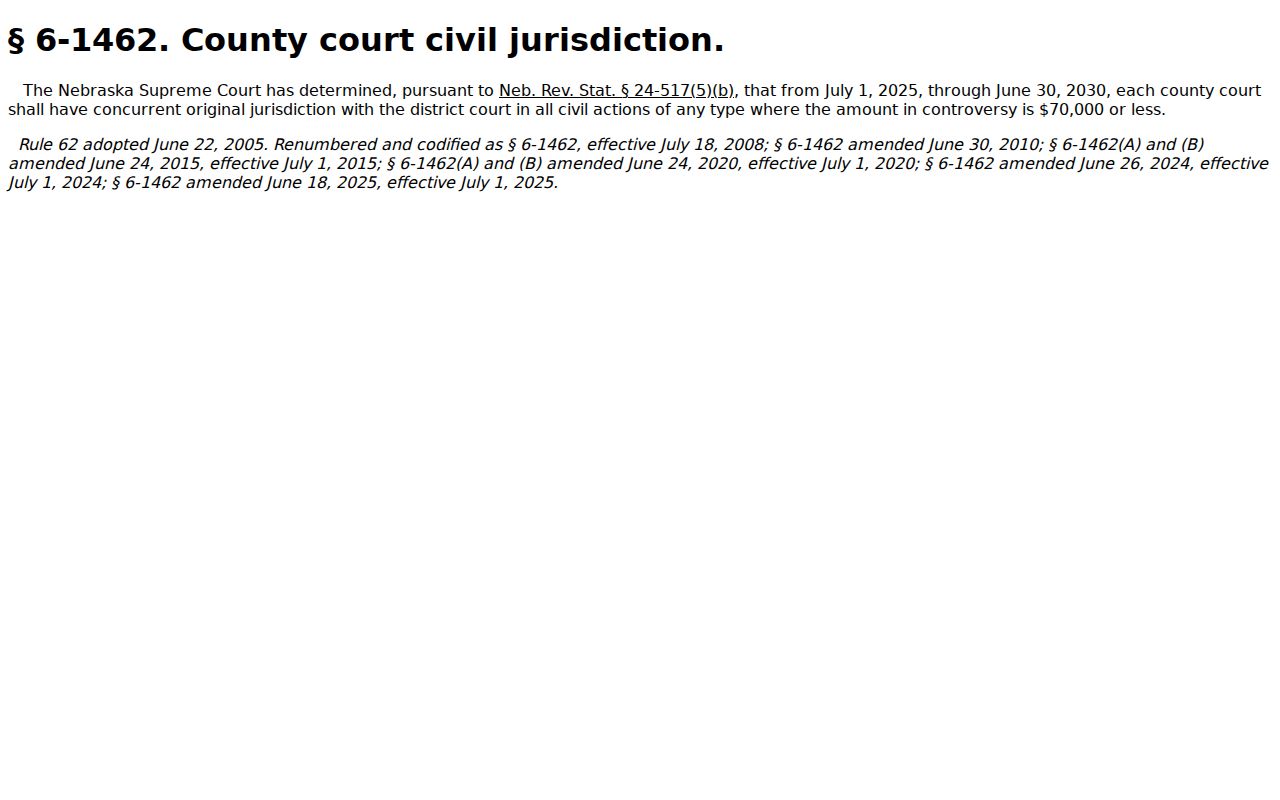
The effective-date language matters here. Jurisdictional limits can change, so the live rule remains the reliable word on where a civil case belongs.
What Cases Fill the Civil Docket
Civil dockets in Antelope County hold more than contract and property fights. County Court files include civil actions and small claims. They also hold probate and estate proceedings, guardianships and conservatorships, adoptions, protection orders, and some domestic-relations reporting categories. District Court records cover general civil cases, domestic relations, appeals, and administrative appeals. Each category carries its own procedural language and its own access limits.
- Small claims: a County Court category with its own $7,500 cap and procedure.
- Probate and estates: County Court records that can contain public and restricted documents.
- Guardianship or conservatorship: County Court files where sensitive personal material may not be accessible online.
- Protection orders: County Court proceedings that are not ordinary damages cases.
- Domestic relations and appeals: District Court docket categories that should be searched separately from the originating County Court case.
Note: A visible Antelope County civil caption does not mean every underlying filing or image is public or available through JUSTICE.
Antelope County Civil Filing Mix
The official FY2025 County Court Caseload Report counts 136 civil, 34 probate, 15 small-claims, and 10 guardianship or conservatorship filings in Antelope County. Those numbers make County Court the likely first stop. Most local civil docket questions start there. Remember, they count filings only. They say nothing about unique parties, open cases, outcomes, or searchable documents.
The District Court report shows 24 civil and 14 domestic-relations filings in Antelope for the same fiscal year, plus one appellate action and one administrative appeal. The reports sort cases by court level. A matter that moves on appeal can show up in both courts without becoming two separate civil disputes.
Hearings on the Civil Docket
A civil docket setting in Antelope County can take many forms: a motion hearing, status conference, probate hearing, protection-order hearing, small-claims hearing, bench trial, jury trial, or appeal hearing. Read each setting line with the court level, date, time, location, and proceeding label together. Why start with the newest event? A later continuance, reset, cancellation, or order can change what an older listing means.
The public calendar helps with current or upcoming settings. It is not the full case record, though. If a live calendar and the register disagree, trust the latest filed notice or order. Confirm with the responsible clerk. The court posts no Antelope-specific daily civil docket PDF and no local setting-code legend.
For settings alone, the separate Antelope County court schedule covers the Multi-Court Case Calendar. It also gives the clerk fallback route.
Antelope County Civil Register Terms
Think of a civil register as a timeline. It is not a stand-in for the court file. Nebraska's District Court record rule treats the register as an official chronological summary, while the case file holds the pleadings, motions, orders, judgments, verdicts, and other documents. Event labels help you find the next document or hearing. A label does not decide legal effect. A pending-motion entry is a request, so never guess what an order says from that line alone.
- Complaint or petition
- The filing that begins a civil or statutory proceeding.
- Return of service
- An entry showing service-related action, which can be separate from the pleading itself.
- Answer or counterclaim
- A responding filing that can appear after service in a civil case.
- Order
- The court's direction or ruling. It differs from a motion that merely requests action.
- Judgment
- A formal resolution of a claim that can be followed by collection, payment, or appeal activity.
An appellate action in District Court needs care. Look for the District Court caption and its separate docket number, and keep the County Court number handy for clerk routing.
Who Can See Civil Dockets
Nebraska's court access rules open public electronic information through authorized remote access and courthouse terminals. Expect fees, outages, redaction, and exclusions along the way. Antelope County offers a free courthouse JUSTICE terminal. It is the local alternative to paid internet search. The court-records search policy also documents clerk searches, copies, certified copies, and written Public Records Act requests as access routes.
What is missing matters too. Restricted probate, guardianship, adoption, juvenile, sealed, and protected information can drop out of a public display. An absent image never proves an entry did not happen. Start with the court and the exact document. Then ask the right clerk which public copy route applies. Clerks work best with a complete party name plus case year and type. The policy does not promise a general no-record certificate.
Nebraska's court-records search policy sets out these access rules for this Antelope County civil docket image.
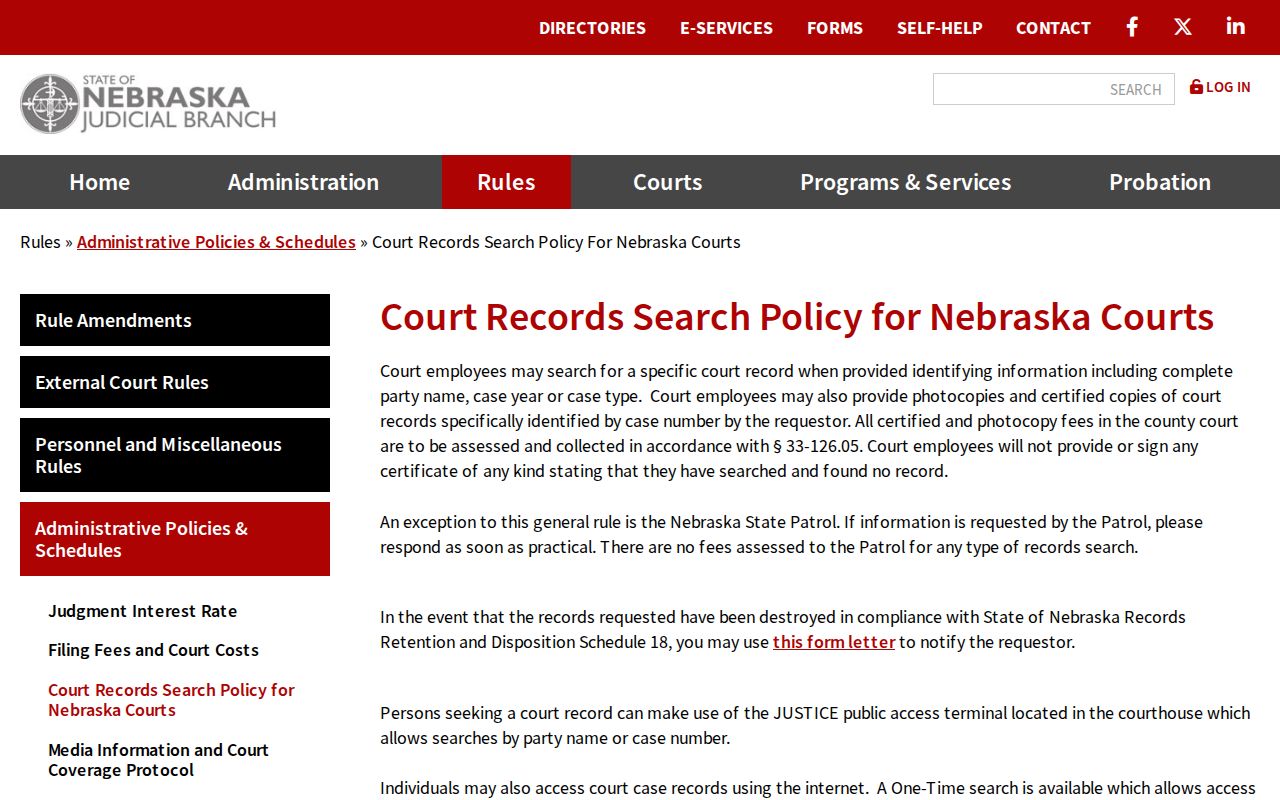
The policy shines when a party-name search comes up short. A clerk can then use the court, year, type, or case number to locate the file.
Access point: Article 8 governs electronic access to public court records. The Nebraska Public Records Act supplies the written-request framework, but court-specific restrictions continue to control sealed and protected records.
Antelope County Civil Copy Requests
Send each copy request to the court that keeps the civil record. County Court requests go to the County Court Clerk Magistrate, while District Court requests go to the Clerk of the District Court. In your request, identify the court, Antelope County, case number, case name, document name or date, copy type, and recipient contact information. Say whether you want email, mail, or pickup. Both offices share the local courthouse site but keep separate records duties and post-office boxes.
The CC 3:29 copy-request form spells out the charges. Electronic non-certified copies come without charge. Mailed non-certified copies cost $0.25 per page. Electronic certified copies run $1 per request. Mailed certified copies cost $1 per seal plus $0.25 per page. Those are copy costs only. Filing a new civil case carries its own separate fees. A clerk may require prepayment, and the official materials promise no universal turnaround.
The current filing-fee and court-cost schedule lists these charges for this Antelope County civil docket image.
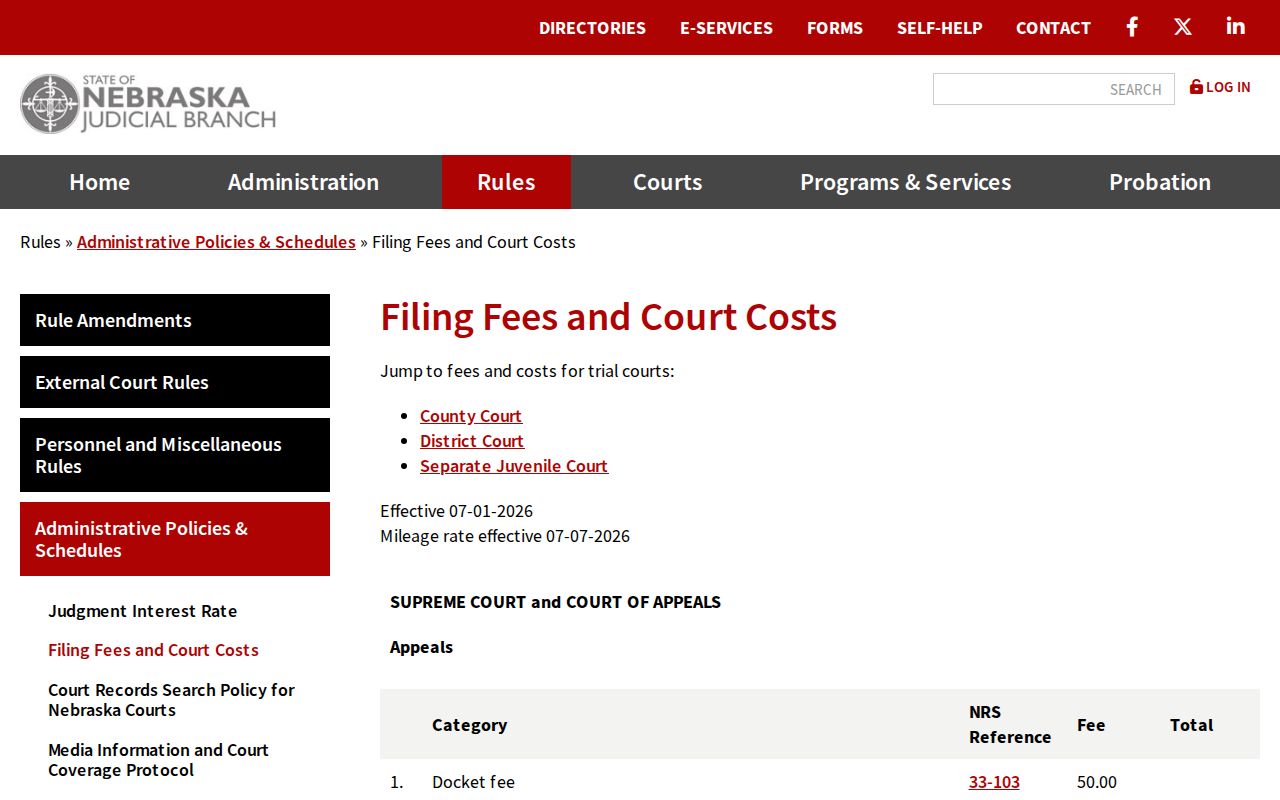
Check the schedule live before you budget. Filing costs, court costs, and clerk copy fees are separate charges, and each can change.